Pierre Paul Brandebourg était un peintre et photographe luxembourgeois. Il est considéré comme le pionnier de la photographie au Luxembourg et a ouvert le premier studio photo du pays. Outre la peinture, dans laquelle il s’intéressait principalement aux ouvriers et aux scènes industrielles, il s’est spécialisé dans la photographie de portrait. Son atelier situé sur le Marché-aux-Poissons (Fëschmaart) est rapidement devenu célèbre. Après sa mort, Charles Bernhoeft, lui aussi photographe de renom, a repris son atelier.
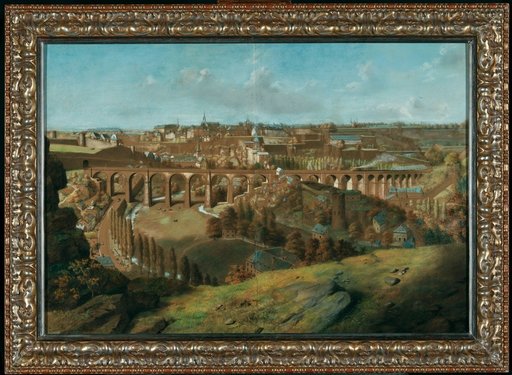
La vue de la ville de grand format est pittoresque. Elle montre de petits détails anecdotiques tels que des ouvriers, leurs véhicules et leurs bêtes de somme. Cette œuvre a été réalisée avant le démantèlement de la forteresse. Le viaduc et la ville étirée en arrière-plan ont un aspect majestueux et confèrent à la ville un caractère à la fois pittoresque et fort.
Pierre Paul Brandebourg war ein luxemburgischer Maler und Fotograf. Er gilt als Pionier der Fotografie in Luxemburg und eröffnete das erste Fotostudio des Landes. Neben der Malerei, in der er vor allem Arbeiter und industrielle Szenen darstellte, spezialisierte er sich auf die Porträtfotografie. Sein Atelier am Fischmarkt (Fëschmaart) wurde schnell bekannt. Nach seinem Tod übernahm Charles Bernhoeft, ebenfalls ein renommierter Fotograf, sein Atelier.
Die großformatige Stadtansicht ist detailreich und malerisch. Sie zeigt kleine anekdotische Details wie Arbeiter, ihre Fahrzeuge und Arbeitstiere. Das Bild entstand vor Schleifung der Festung. Das Viadukt und die langestreckte Stadt im Hintergrund wirken majestätisch und verleihen der Stadt nicht nur einen pittoresken, sondern auch starken Charakter.
Pierre Paul Brandebourg was a Luxembourgish painter and photographer. He is considered a pioneer of photography in Luxembourg and opened the country's first photographic studio. In addition to painting, in which he mainly depicted workers and industrial scenes, he specialised in portrait photography. His studio at the Fisch Market (Fëschmaart) quickly became well known. After his death, Charles Bernhoeft, also a renowned photographer, took over his studio.
The large-format city view is full of detail and very picturesque. It shows small anecdotal details such as workers, their vehicles and work animals. The picture was drawn before the dismantling of the fortress. The viaduct and the stretched-out city in the background look majestic and give the city not only a picturesque, but also a strong character.
Will Kesseler, peintre luxembourgeois et double lauréat du Prix Grand-Duc Adolphe (1946 et 1950), est considéré comme l'un des meilleurs coloristes du pays.
D’abord enraciné dans les traditions académiques, l’art de Kesseler s’est développé fortement après qu’il a travaillé comme chef de projet pour des entreprises de construction ferroviaire au Congo belge et au Tchad. Cette période à l’étranger a influencé sa production artistique variée, qui comprend des natures mortes, des études de fleurs, des paysages du Luxembourg et d’Afrique, des figures, des nus et des œuvres abstraites.
En 1951, Kesseler s’est tourné vers la peinture abstraite. Ses œuvres se caractérisent par des couleurs vives et pures, en particulier le jaune, le bleu, le rouge et le vert intense. Des compositions dynamiques de formes géométriques et courbes laissent entrevoir une végétation tropicale. Bien qu’il soit surtout connu pour ses gouaches d’inspiration africaine, Kesseler a également créé des vues colorées de villes.
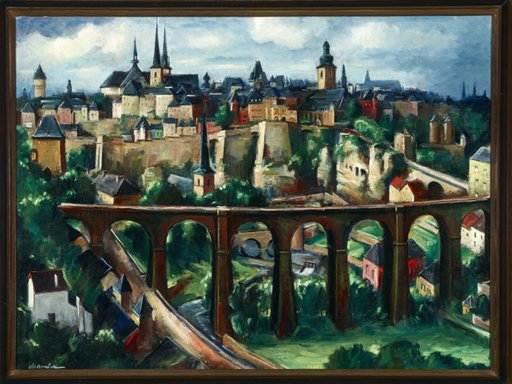
Le viaduc est clairement au centre de la composition présentée ici. Les tons chauds de l’architecture contrastent avec le vert intense de la végétation et le ciel dramatiquement nuageux. La scène transmet une profondeur atmosphérique et reflète le charme de la capitale luxembourgeoise.
Will Kesseler, luxemburgischer Maler und zweifacher Gewinner des Prix Grand-Duc Adolphe (1946 und 1950), gilt als einer der besten Koloristen des Landes.
Anfangs in akademischen Traditionen verwurzelt, entwickelte sich Kesselers Kunst stark weiter, nachdem er im damaligen Belgisch-Kongo und in Tschad als Projektleiter für Eisenbahnbauunternehmen tätig war. Diese Zeit im Ausland prägte seine vielfältige künstlerische Produktion, die Stillleben, Blumenstudien, Landschaften aus Luxemburg und Afrika, Figuren, Akte und abstrakte Werke umfasst.
1951 wandte sich Kesseler der abstrakteren Malerei zu. Seine Werke zeichnen sich durch lebendige, reine Farben aus, insbesondere Gelb, Blau, Rot und kräftiges Grün. Dynamische Kompositionen aus geometrischen, geschwungenen Formen lassen tropische Vegetation erahnen. Obwohl er vor allem für seine afrikanisch inspirierten Gouachen bekannt ist, schuf Kesseler auch farbenfrohe Stadtansichten.
Das Viadukt steht eindeutig im Mittelpunkt der hier vorgestellten Komposition. Die warmen Erdtöne der Architektur kontrastieren mit dem satten Grün der Vegetation und dem dramatisch bewölkten Himmel. Die Szene vermittelt atmosphärische Tiefe und spiegelt den Charme der luxemburgischen Hauptstadt wider.
Will Kesseler, Luxembourgish painter and twice winner of the Prix Grand-Duc Adolphe (1946 and 1950), is celebrated as one of the nation's finest colorists.
Initially rooted in academic traditions, Kesseler's art evolved significantly after his time in the Belgian Congo and Chad, where his work as a railway project manager deeply influenced his artistic output. His diverse portfolio includes still lifes, floral studies, landscapes from Luxembourg and Africa, figures, nudes, and abstract pieces.
In 1951, Kesseler transitioned to abstract painting, with works distinguished by vibrant, pure colors—particularly yellows, blues, reds, and bold greens. His dynamic compositions feature geometric, curving forms that evoke tropical vegetation. Although he is best known for his African-inspired gouaches, Kesseler also produced colourful cityscapes.
The viaduct is clearly the focal point of the composition in display. The warm, earthy tones of the architecture contrast with the lush green of the vegetation and the dramatic cloudy sky. The scene conveys atmospheric depth and reflects the charm of the Luxembourg capital.
Guido Oppenheim, né le 28 mai 1862 au Luxembourg dans une famille de commerçants juifs, était destiné à intégrer l’entreprise textile familiale. Mais très tôt, il s'est découvert une passion pour la peinture. Il a étudié à la Königliche Akademie der Schönen Künste (Académie royale des beaux-arts) de Munich, puis à l’École des beaux-arts de Paris. Pendant son séjour à Munich, il s’est consacré principalement à la peinture de portraits, mais a découvert en France son amour pour la peinture de paysages. Peu à peu, il a exposé ses œuvres et a gagné la reconnaissance du public parisien.
Au début du 20e siècle, Oppenheim est revenu au Luxembourg en tant qu’artiste réputé. Il a été membre du Cercle Artistique de Luxembourg pendant quelques années avant de se lancer dans une carrière indépendante.
Le déclenchement de la Seconde Guerre mondiale a marqué un tournant tragique dans la vie d’Oppenheim. Le 28 juillet 1942, il a été déporté à Theresienstadt avec ses deux frères. Il y est mort un mois plus tard, le 26 août 1942.
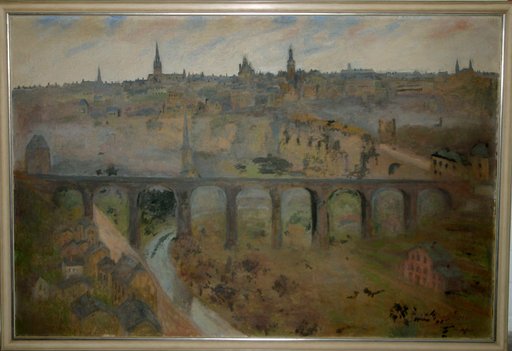
L’œuvre présentée ici n’est pas seulement la plus grande de notre exposition, elle donne aussi l’impression d’être inachevée. En regardant de plus près la toile, on remarque que les dernières couches de peinture semblent manquer, un détail qui confère à l’œuvre une tension et une force narrative particulières. Le musée possède une version presque identique de ce motif, dans un format nettement plus petit, réalisée vers 1920 ou peu avant. Il n’est pas possible à ce jour de déterminer avec certitude laquelle des deux versions a été réalisée en premier. Il est possible que la plus petite ait servi d’étude ou de modèle pour l’œuvre plus grande, mais il est tout aussi concevable qu’elle ait été réalisée ultérieurement comme réplique ou variante.
Guido Oppenheim, geboren am 28. Mai 1862 in eine jüdische Kaufmannsfamilie in Luxemburg, war ursprünglich dazu bestimmt, in das Textilgeschäft der Familie einzutreten. Doch schon früh zeigte sich seine Leidenschaft für die Malerei. Er studierte an der Königlichen Akademie der Schönen Künste in München und später an der École des beaux-arts in Paris. Während seiner Zeit in München widmete er sich vor allem der Porträtmalerei, entdeckte jedoch in Frankreich seine Liebe zur Landschaftsmalerei. Nach und nach stellte er seine Werke aus und gewann die Anerkennung des Pariser Publikums.
Zu Beginn des 20. Jahrhunderts kehrte Oppenheim als angesehener Künstler nach Luxemburg zurück. Einige Jahre war er Mitglied des Cercle Artistique de Luxembourg, bevor er sich für eine unabhängige Karriere entschied.
Der Ausbruch des Zweiten Weltkriegs brachte eine tragische Wendung in Oppenheims Leben. Am 28. Juli 1942 wurde Oppenheim zusammen mit seinen beiden Brüdern nach Theresienstadt deportiert. Er starb dort einen Monat später, am 26. August 1942.
Das hier gezeigte Bild ist nicht nur das größte in unserer Ausstellung, sondern wirkt auch unvollendet. Bei genauer Betrachtung der Leinwand fällt auf, dass die letzten Farbschichten zu fehlen scheinen – ein Detail, das dem Werk eine besondere Spannung und Erzählkraft verleiht. Das Museum besitzt eine grösstenteils identische Version dieses Bildmotivs in deutlich kleinerem Format, entstanden um oder kurz vor 1920. Welche der beiden Fassungen zuerst entstand, lässt sich bislang nicht mit Sicherheit sagen. Möglicherweise diente die kleinere als Studie oder Vorlage für das größere Werk – ebenso denkbar ist jedoch, dass sie nachträglich als Replik oder Variante entstand.
Guido Oppenheim, born on May 28, 1862, into a Jewish merchant family in Luxembourg, was initially expected to join the family’s textile business. However, he was drawn to painting from an early age. He pursued his passion by studying at the Königlichen Akademie der Schönen Künste (Royal Academy of Fine Arts) in Munich and later at the École des beaux-arts (School of Fine Arts) in Paris. In Munich, he focused on portraiture, while his time in France ignited a love for landscape painting. His works gradually gained recognition, earning him the admiration of the Parisian public.
At the turn of the 20th century, Oppenheim returned to Luxembourg as a respected artist. He was an active member of the Cercle Artistique de Luxembourg for several years before choosing to focus on an independent career.
The outbreak of World War II marked a tragic turn in Oppenheim’s life. On July 28, 1942, Oppenheim and his two brothers were deported to Terezín (Theresienstadt), where he died a month later, on August 26, 1942.
The painting shown here is not only the largest in our exhibition, but also appears unfinished. On closer inspection of the canvas, it is noticeable that the last layers of colour seem to be missing – a detail that gives the work a particular tension and narrative power. The museum has a largely identical version of this motif in a significantly smaller format, created around or shortly before 1920. It is not yet possible to say with certainty which of the two versions was created first. It is possible that the smaller version served as a study or template for the larger work, but it is equally conceivable that it was created later as a replica or variant.
Robert Gerstenkorn est né en 1877 à Wetzlar. Il a fréquenté la Kunstgewerbeschule (école des arts et métiers) à Cologne, puis a étudié à Munich et Stuttgart. Gerstenkorn était un peintre paysagiste actif à Coblence, dans l’Eifel et à Bonn.
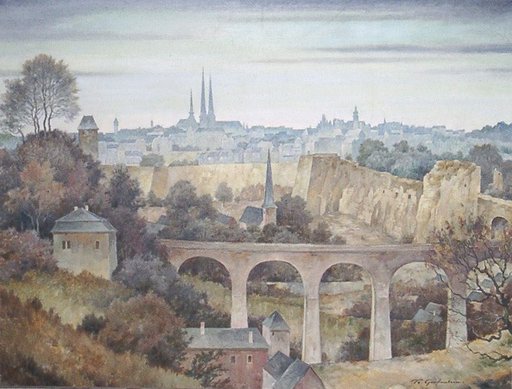
La vue de la ville de Gerstenkorn montre le viaduc de Clausen avec le rocher du Bock à droite et la Tour Jacob à gauche. Au fond, on aperçoit les tours de la cathédrale, et à droite, l’église Saint-Michel, beaucoup plus petite.
Robert Gerstenkorn wurde 1877 in Wetzlar geboren. Er besuchte die Kunstgewerbeschule in Köln und studierte anschließend in München und Stuttgart. Gerstenkorn war als Landschaftsmaler in Koblenz, der Eifel und Bonn tätig.
Gerstenkorns Ansicht zeigt das Viadukt von Clausen mit dem Bockfelsen rechts und dem Tour Jacob links im Bild. Im entfernten Bildhintergrund sind in der Mitte die Türme der Kathedrale zu sehen, während weiter rechts - deutlich kleiner - die Michelskirche erscheint.
Robert Gerstenkorn was born in 1877 in Wetzlar. He attended the Kunstgewerbeschule (arts and crafts school) in Cologne and then studied in Munich and Stuttgart. Gerstenkorn was a landscape painter active in Koblenz, the Eifel and Bonn.
Gerstenkorn's view shows the Clausen Viaduct with the Bock rock on the right and the Jacob Tower on the left. In the distant background, the towers of the cathedral can be seen in the middle, while the St Michael's Church appears further to the right, much smaller.
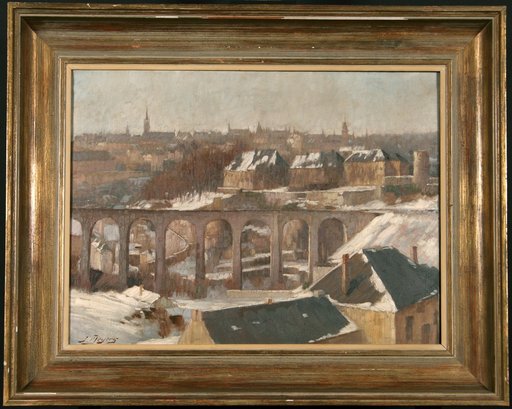
Josy Meyers était un peintre luxembourgeois né à Troisvierges en 1902. Il a étudié à Bruxelles, Munich et Paris. En tant que membre du Cercle Artistique de Luxembourg, il a remporté le Prix Grand-Duc Adolphe en 1927. Meyers était professeur d’éducation artistique au Lycée des Arts et Métiers à Luxembourg. Il est décédé à Strassen en 1970. Le style de cette œuvre de Josy Meyers est réaliste avec des influences impressionnistes.
La composition montre une représentation détaillée et évocatrice du paysage urbain hivernal du Luxembourg.
Josy Meyers, 1902 in Troisvierges geboren, war ein luxemburgischer Maler. Er studierte in Brüssel, München und Paris. Als Mitglied des Cercle Artistique de Luxembourg gewann er 1927 den Prix Grand-Duc Adolphe. Meyers war Kunstlehrer am Lycée des Arts et Métiers (Handwerkerschule) in Luxemburg. Im Jahr 1970 verstarb er in Strassen.
Der Malstil dieses Werks von Josy Meyers ist realistisch mit impressionistischen Einflüssen. Die Komposition zeigt eine detailreiche, stimmungsvolle Darstellung der winterlichen Stadtlandschaft Luxemburgs.
Josy Meyers was a Luxembourgish painter born in Troisvierges in 1902. He studied in Brussels, Munich and Paris. As a member of the Cercle Artistique de Luxembourg, he won the Prix Grand-Duc Adolphe in 1927. Meyers was an art teacher at the Lycée des Arts et Métiers (craftsmen's school). He died in Strassen in 1970.
The painting style of this work by Josy Meyers is realistic with impressionist influences. The composition shows a detailed, atmospheric representation of the winter cityscape of Luxembourg.
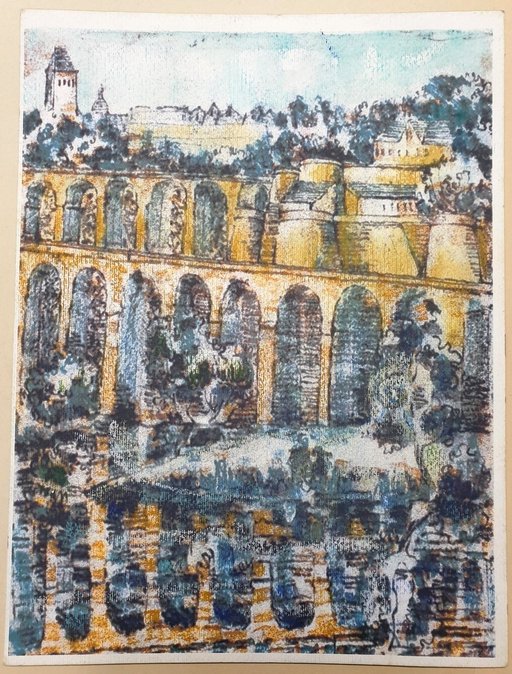
Né en 1937 à Esch-sur-Alzette, Wil Lofy était un artiste luxembourgeois renommé, connu dans tout le Grand-Duché pour ses créations artistiques profondes. En tant qu’artiste, son utilisation habile du métal, du béton, du bois et du marbre pour créer des sculptures significatives lui a valu le respect et l’admiration de beaucoup. Il a étudié en Italie et à l’École nationale supérieure des beaux-arts en France.
Parmi ses créations, on compte la fontaine « Hämmelsmarsch » au cœur de la ville de Luxembourg, commandée en 1982, la fontaine « Maus Ketty » à Mondorf-les-Bains, commandée en 1986 en mémoire du poète luxembourgeois August Liesch, la fontaine « Blannen Theis » à Grevenmacher, commandée en 1991, et la fontaine « Bacchus » (dieu du vin) à Remich, commandée en 1999.
Dans l’œuvre présentée ici, la façon dont il traite les ponts met en avant la lumière, la structure et le mouvement.
Der 1937 in Esch-sur-Alzette geborene Wil Lofy war ein renommierter luxemburgischer Künstler, der im ganzen Großherzogtum für seine künstlerischen und tiefgründigen Kreationen bekannt war. Als Künstler erwarb er sich durch seine geschickte Verwendung von Metall, Beton, Holz und Marmor zur Schaffung bedeutungsvoller Skulpturen den Respekt und die Bewunderung vieler. Er studierte in Italien und an der École nationale supérieure des beaux-arts in Frankreich.
Zu seinen Werken gehören der 1982 in Auftrag gegebene „Schafsbrunnen“ („Hämmelsmarsch“) im Herzen der Stadt Luxemburg, der 1986 in Auftrag gegebene „Maus Ketty“-Brunnen in Mondorf-les-Bains, der 1986 zum Gedenken an den luxemburgischen Dichter August Liesch in Auftrag gegeben wurde, der „Blannen-Theis“-Brunnen in Grevenmacher, der 1991 in Auftrag gegeben wurde, und der „Bacchus“-Brunnen (Wein-Gott) in Remich, der 1999 in Auftrag gegeben wurde.
Die Art und Weise, wie er in dem hier gezeigten Bild die Brücken behandelt, stellt Licht, Struktur und Bewegung in den Vordergrund.
Born in 1937 in Esch-sur-Alzette, Wil Lofy was a renowned Luxembourg artist, known throughout the Grand Duchy for his artistic and profound creations. As an artist, his skilful use of metal, concrete, wood and marble to create meaningful sculptures earned him the respect and admiration of many. He studied in Italy and at the École nationale supérieure des beaux-arts in France.
Some of his creations include the "sheep" fountain ("Hämmelsmarsch") in the heart of Luxembourg City, commissioned in 1982, the "Maus Ketty" fountain in Mondorf-les-Bains, commissioned in 1986 in memory of the Luxembourg poet August Liesch, the "Blannen Theis" fountain in Grevenmacher, commissioned in 1991, and the "Bacchus" (wine god) fountain in Remich, commissioned in 1999.
In the work presented here, the way he treats the bridges puts light, structure and movement in the foreground.
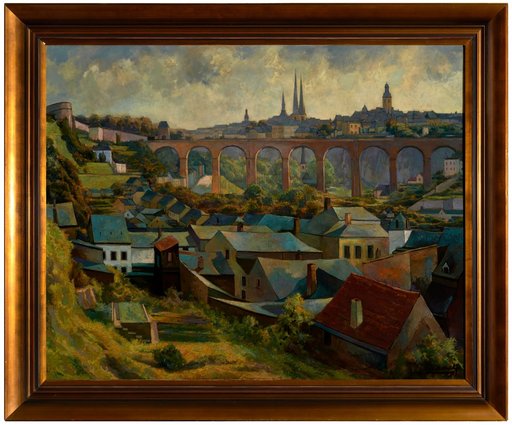
Né à Walferdange en 1895, Jean Schaack était un peintre et graphiste luxembourgeois connu pour ses œuvres réalistes et détaillées. Ses créations comprenaient principalement des paysages, des vues urbaines et des natures mortes, souvent inspirées par son pays d’origine, le Luxembourg. Schaack était membre du Cercle artistique de Luxembourg et participait régulièrement à ses expositions. Son art se caractérise par une précision technique et une attention particulière aux détails, ce qui confère à ses œuvres une qualité intemporelle.
Notre musée possède un large éventail de ses œuvres dans sa collection.
Der 1895 in Walferdange geborene Jean Schaack war ein luxemburgischer Maler und Grafiker, bekannt für seine realistischen und detailreichen Werke. Sein Schaffen umfasste vor allem Landschaften, Stadtansichten und Stillleben, oft inspiriert von seiner Heimat Luxemburg. Schaack war Mitglied des Cercle Artistique de Luxembourg und nahm regelmäßig an deren Ausstellungen teil. Seine Kunst zeichnet sich durch technische Präzision und eine besondere Liebe zum Detail aus, die seinen Werken eine zeitlose Qualität verleiht.
In unserem Museum haben wir eine Vielzahl seiner Arbeiten in der Sammlung.
Born in Walferdange in 1895, Jean Schaack was a Luxembourgish painter and graphic artist, known for his realistic and detailed works. His creations mainly included landscapes, cityscapes, and still lifes, often inspired by his home country, Luxembourg. Schaack was a member of the Cercle Artistique de Luxembourg and regularly participated in its exhibitions. His art is characterized by technical precision and a particular attention to detail, giving his works a timeless quality.
Our museum holds a wide range of his works in its collection.