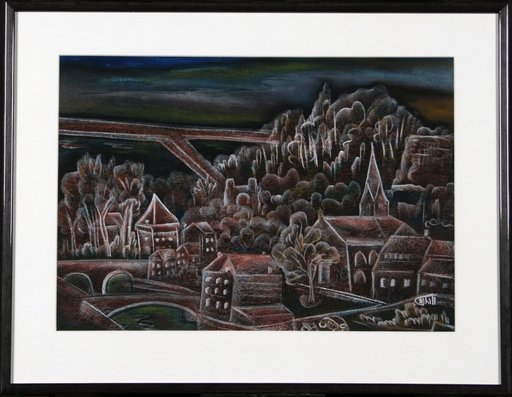
Marcel Thill était autodidacte. Il peignait et travallait la céramique. En 1968, il a fait ses débuts avec une exposition individuelle au Cercle Municipal, où il a présenté une soixantaine de tableaux, pour la plupart abstraits. Il était membre du Cercle artistique de Luxembourg et exposait régulièrement dans les salons annuels. Les œuvres de Thill ont souvent quelque chose de presque onirique.
Le pont Grande-Duchesse Charlotte, construit selon les plans de l’architecte Egon Jux et inauguré le 24 octobre 1966, est familièrement appelé « le pont Rouge ». Il se trouve au centre de la photo. Cet élégant pont basculant d’une longueur de 355 mètres et d’une hauteur de 74 mètres enjambe le quartier de Pfaffenthal. Il relie le quartier européen de Kirchberg au centre-ville de Luxembourg. Après son inauguration, le pont a attiré pendant des années des candidats au suicide. En 1990, un mur de protection en plexiglas a été installé pour dissuader d’autres personnes de sauter du pont. Le film Le Pont rouge de Geneviève Mersch documente les expériences des habitants du quartier de Pfaffenthal qui vivent sous le pont Rouge.
Als Autodidakt malte und arbeitete Thill mit Keramik. 1968 hatte er sein Debüt mit einer Einzelausstellung von rund 60 meist abstrakten Bildern im Cercle Municipal. Er war Mitglied des Cercle artistique de Luxembourg und stellte regelmäßig bei den jährlichen Salons aus. Thills Arbeiten haben oft etwas fast traumhaftes an sich.
Die nach Plänen des Architekten Egon Jux erbaute und am 24. Oktober 1966 eingeweihte Großherzogin-Charlotte-Brücke wird im Volksmund „Rote Brücke“ genannt und steht im Mittelpunkt des Bildes. Die elegante, selbsttragende Stahlkonstruktion überspannt mit einer Länge von 355 Metern und einer Höhe von 74 Metern den Stadtteil Pfaffenthal. Sie verbindet das Europaviertel auf dem Kirchbergplateau mit der Luxemburger Innenstadt. Nach ihrer Einweihung zog die Brücke jahrelang Selbstmörder an. 1990 wurde eine Schutzwand aus Plexiglas installiert, um weitere Sprünge von der Brücke zu verhindern. Der Film „Le Pont rouge“ von Geneviève Mersch dokumentiert die Erfahrungen der Bewohner von Pfaffenthal, die unter der Roten Brücke leben.
Thill taught himself and painted and worked with ceramics. He debuted with a solo exhibition at the Cercle Municipal in 1968 with around 60 mostly abstract paintings. He was a member of the Cercle artistique de Luxembourg and regularly exhibited at the annual salons. There is often something almost dreamlike about Thill's works.
The Grand Duchess Charlotte Bridge, built according to the plans of the architect Egon Jux and inaugurated on 24 October 1966, is popularly known as the ‘Red Bridge’ and is the focus of the painting. The elegant, self-supporting steel construction spans the Pfaffenthal district with a length of 355 metres and a height of 74 metres. It connects the European Quarter on the Kirchberg plateau with Luxembourg city centre. For years after its inauguration, the bridge attracted suicides. In 1990, a plexiglass barrier was installed to prevent further jumps from the bridge. The film ‘Le Pont rouge’ by Geneviève Mersch documents the experiences of the residents of Pfaffenthal who live under the Red Bridge.
Will Faber est né le 25 mai 1901 à Sarrebruck. En 1924, il a commencé des études de peinture à Munich, mais a déménagé deux ans plus tard à Berlin où il s’est lié d’amitié avec Käthe Kollwitz et Willi Jäckel. À cette époque, son œuvre était fortement influencée par l’expressionnisme.
Faber a quitté l’Allemagne en 1934 et s’est installé à Barcelone. Inspiré par les cubistes, les futuristes et les dadaïstes, il a entamé en Espagne une nouvelle phase de sa peinture. Faber a intégré des lettres individuelles dans ses tableaux et les a entremêlées avec des détails calligraphiques et picturaux pour former un tout cohérent. Faber était fasciné par l’espace et le cosmos. Il a introduit des éléments du chaos cosmique dans son œuvre, créant ainsi une unité chaotique. En 1934, il s’est installé à Ibiza pour échapper à la guerre civile espagnole. Après une longue carrière, il est mort sur l’île en 1987.
Will Faber wurde am 25. Mai 1901 in Saarbrücken geboren. 1924 begann Faber in München Malerei zu studieren, zog aber zwei Jahre später nach Berlin, wo er sich mit Künstler*innen wie Käthe Kollwitz und Willi Jäckel anfreundete. Zu dieser Zeit war sein Werk stark vom Expressionismus beeinflusst.
1934 verließ Faber Deutschland und ging nach Barcelona. In Spanien begann er, inspiriert von Kubisten, Futuristen und Dadaisten, eine neue Phase in seiner Malerei. Faber integrierte einzelne Buchstaben in seine Gemälde und verflochte sie mit kalligrafischen und malerischen Details, um ein einheitliches Ganzes zu schaffen. Fasziniert vom Weltraum und dem Kosmos, führte Faber Elemente des kosmischen Chaos in seine Arbeit ein und schuf so eine chaotische Einheit. Auf der Flucht vor dem Spanischen Bürgerkrieg zog er 1934 nach Ibiza. Nach einer langen Karriere starb er 1987 auf der Insel.
Will Faber was born in Saarbrücken on 25 May 1901. In 1924 Faber began studying painting in Munich, but two years later he moved to Berlin, where he became friends with artits like Käthe Kollwitz and Willi Jäckel. At this time his work was strongly influenced by Expressionism.
Faber left Germany for Barcelona in 1934. Inspired by the Cubists, Futurists and Dadaists, he began a new phase in his painting in Spain. Faber incorporated individual letters into his paintings, interweaving them with calligraphic and painterly details to create a unified whole. Fascinated by space and the cosmos, Faber introduced elements of cosmic chaos into his work, creating a chaotic unity. Fleeing the Spanish Civil War, he moved to Ibiza in 1934. After a long career, he died on the island in 1987.
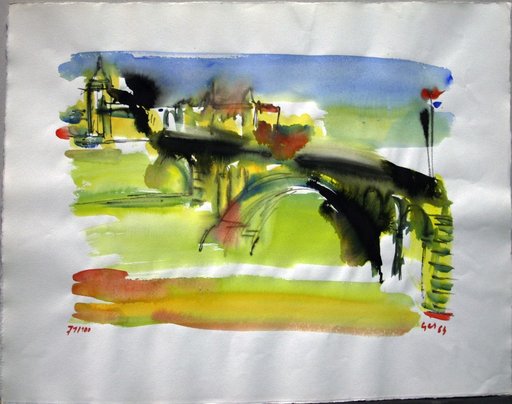
Germaine Maas est née le 4 février 1931 à Wiltz. En 1948, sa famille a déménagé à Remich, où la future artiste s’est prise de passion pour la Moselle.
À 15 ans, elle est entrée à l’École nationale des arts décoratifs de Luxembourg, où Lucien Wercollier enseignait également, puis elle est partie étudier à Paris. Après son retour au Luxembourg, elle a travaillé comme rédactrice à la Revue, avant de se consacrer à d’autres journaux à partir de 1952. Elle a poursuivi sa formation à Munich et a fréquenté en 1961 l’« École du regard » d’Oskar Kokoschka à Salzbourg.
À Munich, elle a épousé Alexander von Neuhoff von der Ley, avec qui elle a eu une fille, Tamara, en 1956. Après son divorce en 1965, elle s’est installée à Luxembourg-ville et a travaillé dans des ateliers à Paris et à Bruxelles.
Son œuvre variée, qui comprend des paysages, des fleurs et des scènes vivantes, est reconnue dans toute l’Europe. En 2012, une grande rétrospective a été organisée et Ger Maas a reçu le Prix Européen. Outre la peinture, l’artiste illustrait des livres et écrivait des poèmes. L’aquarelle montrée dans l’exposition n’est qu’une des nombreuses œuvres de Germaine Maas dans nos collections.
Ici, on y voit le pont Adolphe traversant l’image. À l’arrière-plan à gauche, nous voyons le célèbre bâtiment de la Banque et Caisse d’Épargne de l’État, avec sa tour emblématique. Les couleurs et la manière expressive de peindre rendent la composition vivante et captivante.
Germaine Maas wurde am 4. Februar 1931 in Wiltz geboren. 1948 zog die Familie nach Remich – dort erwachte ihre lebenslange Liebe zur Mosel.
Bereits mit 15 Jahren besuchte sie die Staatliche Kunstgewerbeschule in Luxemburg, wo auch Lucien Wercollier unterrichtete. Später setzte sie ihr Studium in Paris fort. Nach ihrer Rückkehr nach Luxemburg arbeitete sie zunächst als Redakteurin bei der Revue, bevor sie sich ab 1952 anderen Zeitungen widmete. Ihre künstlerische Ausbildung führte sie anschließend nach München und 1961 an die renommierte „Schule des Sehens“ von Oskar Kokoschka in Salzburg.
In München heiratete sie Alexander von Neuhoff von der Ley. 1956 kam ihre Tochter Tamara zur Welt. Nach der Scheidung 1965 kehrte sie nach Luxemburg-Stadt zurück und arbeitete in Ateliers in Paris und Brüssel.
Ihr vielfältiges Werk – von Landschaften und Blumen bis hin zu lebendigen Szenen – fand europaweit Anerkennung. 2012 wurde ihr Schaffen mit einer großen Retrospektive gewürdigt, und Ger Maas erhielt den Prix Européen. Neben der Malerei illustrierte sie Bücher und verfasste Gedichte. Dies ist nur eines von vielen Werken Germaine Maas’ in unseren Sammlungen.
Hier blicken wir auf die Adolphe-Brücke, die sich quer durch das Bild zieht. Im linken Hintergrund erhebt sich das markante „Spuerkeess“-Gebäude mit seinem ikonischen Turm. Die leuchtenden Farben und die expressive Malweise verleihen der Komposition Dynamik und emotionale Tiefe.
Germaine Maas was born in Wiltz on 4 February 1931. In 1948, the family moved to Remich, where she developed a love for the Moselle region.
At 15, she attended the National School of Decorative Arts in Luxembourg, where Lucien Wercollier also taught, and later studied in Paris. On her return to Luxembourg, she worked as an editor at the Revue journal before devoting herself to other newspapers from 1952. She continued her education in Munich and attended Oskar Kokoschka's ‘School of Seeing’ in Salzburg in 1961.
In Munich, she married Alexander von Neuhoff von der Ley, with whom she had a daughter, Tamara, in 1956. After her divorce in 1965, she moved to Luxembourg City and worked in studios in Paris and Brussels.
Her versatile work, which includes landscapes, flowers and lively scenes, has been recognised throughout Europe. In 2012, a major retrospective was held and Ger Maas received the Prix Européen. In addition to her painting, the artist illustrated books and wrote poetry. This is just one of many works by Germaine Maas in our collections.
Here we are looking at the Adolphe bridge, which runs across the picture. In the background on the left, we see the well-known "Spuerkeess" building with its iconic tower. The colours and expressive painting style make the composition lively and captivating.
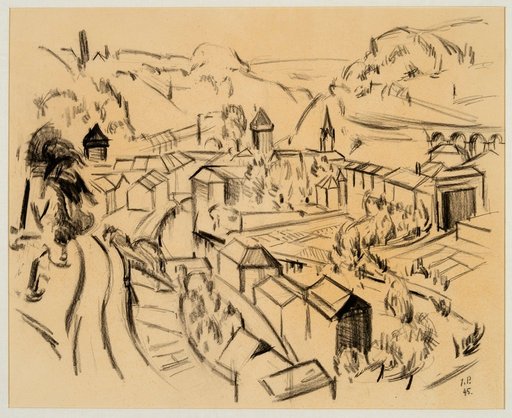
Joseph Probst est né en 1911 à Vianden. Il a fait des études de beaux-arts à Bruxelles et à Vienne. On retrouve chez Joseph Probst l’influence de l’« École de Paris ». Ses travaux portent la marque d’un discours formel toujours plus simplifié et d’une palette de couleurs toujours plus intense. Ses travaux non figuratifs ont débuté en 1951, lorsqu’il s’est rapproché très nettement de l’abstraction lyrique. En 1954, il a fondé les « Iconomaques », un groupe d’artistes luxembourgeois qui pratiquaient l’art abstrait et rompaient ainsi avec la peinture figurative, prédominante à l’époque. La forme et la couleur de ses travaux se fondent pour former une unité stylistique dense. L’œuvre exposée ici séduit avant tout par l’abstraction des bâtiments représentés et leur caractère esquissé mais expressif. L’œuvre est signée et datée en bas à droite de l’image.
Joseph Probst wurde 1911 in Vianden geboren. Er studierte Kunst in Brüssel und Wien. Probst stand unter dem Einfluß der „École de Paris“. Seine Arbeiten sind geprägt von einer sich immer weiter reduzierenden Formensprache und zunehmendem Farbreichtum. Ab 1951 arbeitete er erstmals an nicht-figurativen Werken und näherte sich stark der lyrischen Abstraktion an. 1954 gründete er die „Iconomaques“, eine Gruppe abstrakter Künstler in Luxemburg, die sich gegen die damals vorherrschende figürliche, gegenständliche Malerei wandten. Form und Farbe verschmelzen in seinen Werken zu einer festgeschlossenen Stileinheit. Die hier ausgestellte Arbeit besticht vor allem durch die Abstraktion der dargestellten Gebäude und ihren skizzenhaften aber ausdruckstarken Charakter. Die Arbeit ist signiert und datiert unten rechts im Bild.
Joseph Probst was born in 1911 in Vianden. He studied art in Brussels and Vienna. Probst was influenced by the ‘École de Paris’. His work is characterised by a gradually receding form language and an increasing colour richness. He started working on non-figurative works for the first time in 1951, strongly approaching lyrical abstraction. In 1954, he founded the ‘Iconomaques’, a group of abstract artists in Luxembourg who turned away from the figurative objective painting that was prevalent at the time. In his works, form and colour blend into a firmly closed coherent unit of style. The work exhibited here is particularly captivating due to the abstraction of the buildings depicted and their sketchy yet expressive character. The work is signed and dated on the bottom right of the image.
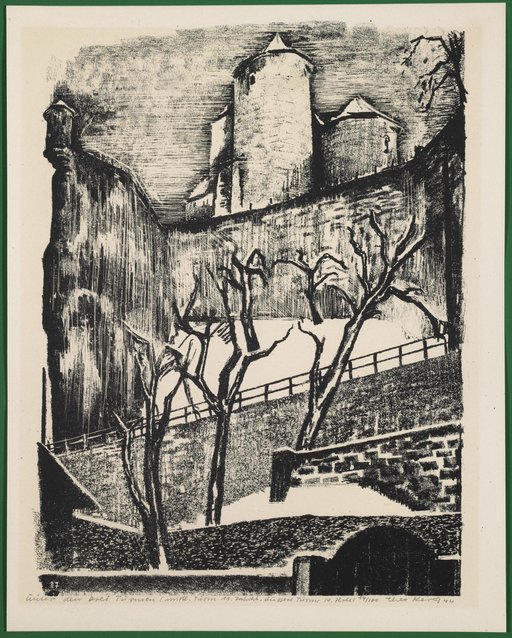
Théo Kerg est né à Niederkorn en 1909. Après une première formation à Paris à l’École supérieure des beaux-arts, il est devenu l’élève de Paul Klee à la Kunstakademie de Düsseldorf. Son œuvre se distingue tout particulièrement par l’analyse critique de son temps et des conditions de vie. Il s’est tourné vers une esthétique non figurative. À partir des années 1950, ses huiles hésitaient entre abstraction et figuration. C’est à cette époque qu’il a inventé le « tactilisme », une forme d’art basée sur le sens du toucher. Cette forme oscille entre des surfaces peintes telles des reliefs et ce qu’il appelait des « environnements » praticables, constitués de plusieurs parties.
La vue de la ville exposée ici est centrée sur les trois tours du Pfaffenthal. La tour carrée centrale de l’ouvrage date de l’époque de la première enceinte fortifiée (probablement vers 1200) ; elle a été flanquée de deux tours rondes au 14e siècle. Pendant des siècles et jusqu’en 1810, la « porte des Trois-Tours » servait de porte d’entrée à la ville haute et de prison.
Théo Kerg wurde 1909 in Niederkorn geboren. Nach einer ersten Ausbildung in Paris an der École supérieure des beaux-arts wurde er Schüler von Paul Klee an der Kunstakademie in Düsseldorf. Sein Werk zeichnet sich insbesondere durch eine kritische Auseinandersetzung mit dem Zeitgeschehen und mit menschlichen Lebenssituationen aus. Er wandte sich der gegenstandslosen Ästhetik zu. Ab den 1950er Jahren entstanden zwischen Abstraktion und Figuration liegende Ölarbeiten. In diesen Jahren erfand er den „Taktilismus“, eine auf dem Tastsinn beruhende Kunstform. Diese bewegt sich von gemalten, reliefartigen Oberflächen bis hin zu begehbaren, sogenannten „Environments“, die aus mehreren Teilen bestehen.
Im Mittelpunkt der hier ausgestellten Stadtansicht stehen die drei Türme im Pfaffenthal. Der quadratische Hauptturm der Anlage stammt aus der Zeit der ersten Stadtmauer (wahrscheinlich um 1200); im 14. Jahrhundert wurde er mit zwei Rundtürmen flankiert. Über Jahrhunderte und bis 1810 diente das „Drei-Türme-Tor“ als Eingangstor zur Oberstadt und als Gefängnis.
Théo Kerg was born in Niederkorn in 1909. After his initial training in Paris at the École supérieure des beaux-arts, he became a student of Paul Klee at the Kunstakademie in Düsseldorf. His work was characterised in particular by a critical assessment of current events and human life situations. He turned to non-representational aesthetics. From the 1950s onwards, he created oil paintings that fluctuated between Abstraction and Figuration. During these years, he invented ‘Tactilism’, a form of art based on the sensation of touch. This ranged from painted, relief-like surfaces to accessible ‘environments’, consisting of several parts.
The cityscape exhibited here centres on the three towers in Pfaffenthal. The central square tower of the structure dates from the time of the first fortified enclosure (probably around 1200); it was flanked by two round towers in the 14th century. For centuries and until 1810, the ‘Three Towers Gate’ served as the entrance to the upper city and as a prison.
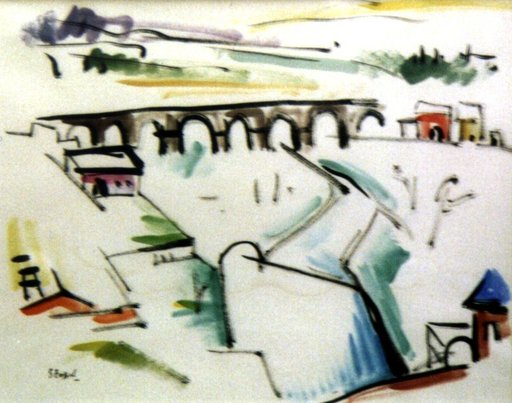
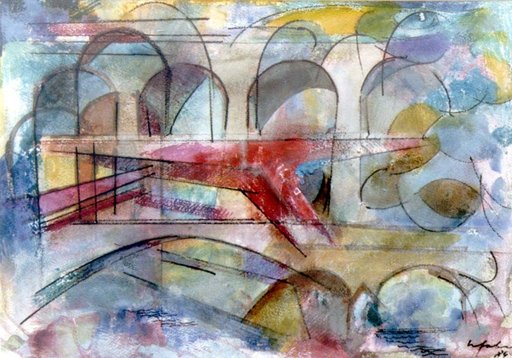
Michel Stoffel est né à Bissen en 1903. Il a été d’abord élève de la Kunstakademie de Weimar, puis de l’Académie des beaux-arts de Bruxelles. Le Prix Grand-Duc Adolphe lui a été décerné en 1936. Membre, notamment, du Cercle Artistique de Luxembourg, il est considéré comme l’un des initiateurs, en 1954, des « Iconomaques ». Le travail de ce groupe se caractérise par des formes abstraites, souvent géométriques, qui cherchent à se démarquer précisément de l’art figuratif, jusque-là largement répandu.
Sur l’aquarelle présentée ici, le viaduc domine au centre. La tour Jacob est représentée à l’avant droit. La vision de la ville de Stoffel est très abstraite et il faut bien connaître l’architecture de la ville pour la reconnaître.
Michel Stoffel wurde 1903 in Bissen geboren. Er war zunächst Schüler der Kunstakademie in Weimar und anschließend der Académie des Beaux-Arts in Brüssel. 1936 wurde ihm der Prix Grand-Duc Adolphe verliehen. Er war unter anderem Mitglied des Cercle Artistique de Luxembourg und gilt als einer der Initiatoren der „Iconomaques“ im Jahr 1954. Merkmal der Gruppe ist ein Arbeiten in abstrakten, oft geometrischen Formen und eine möglichst genaue Abgrenzung gegenüber der bis dato weitverbreiteten figurativen Kunst.
Auf dem hier gezeigten Aquarell dominiert das Viadukt in der Mitte. Der Jakobs-Turm ist vorne rechts dargestellt. Stoffels Stadtvision ist stark abstrahiert und erfordert ein gutes Wissen über die Stadtarchitektur, um sie wiederzuerkennen.
Michel Stoffel was born in Bissen in 1903. He was first a student at the Kunstakademie in Weimar and then at the Académie des beaux-arts in Brussels. He was awarded the Grand-Duc Adolphe Prize in 1936. A member of the Cercle Artistique de Luxembourg, among others, he is considered to be one of the initiators of the ‘Iconomaques’ in 1954. The work of this group was characterised by its abstract, often geometric forms, distancing itself as far as possible from the figurative art that was widespread at the time.
In the watercolour shown here, the viaduct dominates the centre. The Jacob tower is shown in the front right. Stoffel's city vision is highly abstracted and requires a good knowledge of urban architecture to recognise.
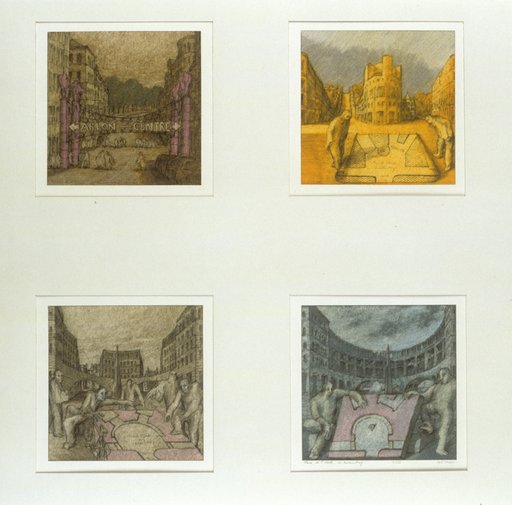
La proposition de Rob Krier pour la place de l’Étoile à Luxembourg avait pour objectif de renforcer son rôle de point d’entrée clé dans la ville.
Krier a proposé une nouvelle façade semi-circulaire pour la place, inspirée du pont Adolphe, un lien essentiel entre la gare et le centre-ville. Sa conception intègre des plinthes rustiquées, des ouvertures régulièrement espacées et des tours d’angle, reflétant des éléments architecturaux typiques du cœur historique de Luxembourg. Une grande tour centrale s’élève depuis le bâtiment en forme de croissant, rappelant l’Arche de l’Amirauté à Londres.
La structure en croissant est traversée par deux routes, ce qui contribue à son intégration dans le tissu urbain environnant. Les unités résidentielles proposées varient en taille et en type, mais sont disposées autour d’un espace central, accessible par une tour d’escalier généreuse. Par cette approche, Krier a cherché à créer un équilibre harmonieux entre références historiques et urbanisme moderne, renforçant ainsi l’importance de la place de l’Étoile comme porte d’entrée fonctionnelle et esthétique de la ville.
Rob Kriers Vorschlag für den Place de l'Étoile in Luxemburg zielte darauf ab, seine Rolle als wichtiger Eingangspunkt zur Stadt zu stärken.
Krier schlug eine neue halbkreisförmige Fassade für den Platz vor, die von der Adolphe-Brücke inspiriert war, einer wichtigen Verbindung zwischen dem Bahnhofsviertel und dem Stadtzentrum. Sein Entwurf umfasste verrostete Sockel, regelmäßig angeordnete Öffnungen und Ecktürme, die architektonische Elemente widerspiegeln, die im historischen Kern Luxemburgs weit verbreitet sind. Ein großer zentraler Turm erhebt sich aus dem halbmondförmigen Gebäude und erinnert an den Admiralty Arch in London.
Die sichelförmige Struktur wird von zwei Straßen durchschnitten, wodurch sie sich besser in die umliegende städtische Struktur einfügt. Darüber hinaus variieren die geplanten Wohneinheiten in Größe und Typ, sind jedoch um einen zentralen Raum angeordnet, der über einen großzügigen Treppenturm zugänglich ist. Mit diesem Ansatz wollte Krier eine harmonische Mischung aus historischen Bezügen und moderner Stadtplanung schaffen und die Bedeutung des Place de l'Étoile als funktionales und ästhetisches Tor zur Stadt stärken.
Rob Krier's proposal for the Place de l'Étoile in Luxembourg sought to enhance its role as a key entry point to the city.
Krier proposed a new semicircular façade for the square, inspired by the Adolphe Bridge, a key link between the station area and the city centre. His design incorporated rusticated plinths, regularly spaced openings and corner towers, reflecting architectural elements common to Luxembourg's historic core. A large central tower rises from the crescent-shaped building, reminiscent of London's Admiralty Arch.
The crescent structure is intersected by two roads, helping to integrate it into the surrounding urban fabric. In addition, the proposed residential units vary in size and type, but are arranged around a central space accessed via a generous stair tower. Through this approach, Krier sought to create a harmonious blend of historical references and modern urban planning, reinforcing the importance of Place de l'Étoile as a functional and aesthetic gateway to the city.
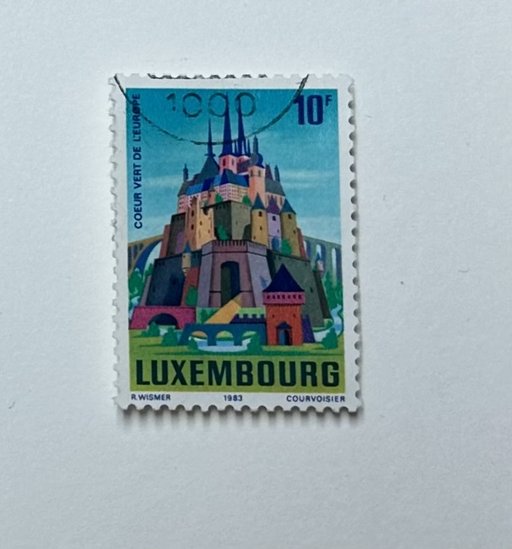
La plus petite œuvre de l’exposition est un timbre conçu par René Wismer. Né en 1917 à Zurich et décédé en 2002, René Wismer a suivi une formation à l’école des arts appliqués de Zurich et de Bâle. Il a ensuite vécu et travaillé comme graphiste et peintre au Grand-Duché de Luxembourg. Wismer a notamment conçu des affiches et des timbres, dont de nombreux exemplaires se trouvent dans notre collection. Il a également participé dans les années 1940 et au début des années 1950 aux « Salons » du Cercle artistique de Luxembourg. Sur cette toute petite « City Vision », tous les bâtiments emblématiques et les monuments de la ville de Luxembourg sont réunis dans une composition de type collage, de la cathédrale et de l’église Saint-Michel au pont Adolphe, en passant par le viaduc.
Das kleinste Werk der Ausstellung ist eine von René Wismer gestaltete Briefmarke. Der 1917 in Zürich geborene und 2002 verstorbene René Wismer erhielt seine Ausbildung an der Kunstgewerbeschule in Zürich und Basel. Später lebte und arbeitete er als Grafiker und Maler im Großherzogtum Luxemburg. Wismer entwarf unter anderem Plakate und Briefmarken, von denen sich zahlreiche Exemplare in unserer Sammlung befinden, und nahm in den 1940er oder frühen 50er Jahren an den „Salons“ des Cercle Artistique de Luxembourg teil. Auf dieser kleinsten „City Vision" sind fast alle emblematischen Gebäude und Wahrzeichen der Stadt Luxemburg in einer collageartigen Komposition vereint – von der Kathedrale und der Michaelskirche bis hin zur Adolphe-Brücke und dem Viadukt.
The smallest work in the exhibition is a postage stamp designed by René Wismer. Wismer, who was born in Zurich in 1917 and died in 2002, received his training at the art schools in Zurich and Basel. He later lived and worked as a graphic designer and painter in the Grand Duchy of Luxembourg. Wismer designed numerous posters and stamps, examples of which can be found in our collection. He also participated in the exhibitions of the Cercle Artistique de Luxembourg in the 1940s and early 50s. This smallest ‘City Vision’ combines almost all the emblematic buildings and landmarks of Luxembourg City in a collage-like composition – from the cathedral and St. Michael's Church to the Adolphe Bridge and the viaduct.